
Diamond Carat Weight: What You're Actually Paying For

The first thing a jeweler asks you is "how many carats?" — and that single number probably drives more overspending than any other part of a diamond purchase. I learned the hard way that carat is the easiest spec to game in your favor, if you understand what it actually measures.
Carat is a unit of weight, not size. One carat equals exactly 200 milligrams — about a fifth of a gram, lighter than a paperclip. The word traces back to the carob seed, which Mediterranean traders once used as a counterweight because the seeds were remarkably consistent in mass. In parts of Asia, grains of rice did the same job, which is why you'll still occasionally hear a one-carat stone described as "four grains." None of that history matters at the counter, but it tells you something useful: carat was always a rough, practical measure, never a measure of how a stone looks on a hand.
Weight is not the same as how big it looks
Here's the part nobody at the jewelry store volunteers. Two diamonds of identical carat weight can look noticeably different in size depending on how they're cut. A stone cut too deep hides much of its weight below the girdle, where you can't see it from the top. You paid for that weight; it just sits underground, doing nothing for the look. A well-proportioned stone of the same weight spreads more of itself across the visible top face and reads as larger. So before you fixate on carat, ask about the stone's diameter in millimeters — that's what your eye actually responds to. I'd happily take a slightly lighter stone that's cut to face up large over a heavier one that's hiding its mass underneath.

The magic-number tax
Prices don't climb smoothly with weight — they jump at round numbers. The leap from 0.90 carat to 1.00 carat can add a startling premium, even though the visual difference is a fraction of a millimeter that no one will ever notice. The same thing happens at 0.50, 1.50, and 2.00. You're paying for the bragging right of saying "a full carat," not for anything you or anyone else can see. My honest advice: shop just below the magic numbers. A 0.92 or 0.95 looks identical to a 1.00 on the finger and can cost meaningfully less. Whether you're choosing a diamond engagement ring or a pair of diamond stud earrings, that single tweak is the cleanest money you'll ever save.
Read the tag carefully on multi-stone pieces
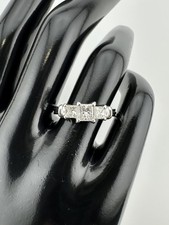
When a piece holds more than one diamond — a diamond halo ring, a diamond tennis bracelet, a three stone diamond ring, or a diamond pendant necklace with accent stones — the tag almost always lists CTW, or carat total weight. That number is the combined weight of every diamond in the piece. It is not the weight of the center stone, and a tag that proudly says "1.50 CTW" might have a center stone of only 0.70 surrounded by a crowd of tiny melee diamonds making up the rest. A ring of dozens of small stones will always look less impressive than a single stone of the same total weight, because small diamonds are cheaper per carat and read as sparkle rather than size. Always ask, in writing, for the carat weight of the largest single stone. If the seller dodges, that's your answer about what they're selling you.
How most people actually buy
Despite all the advertising aimed at one-carat-and-up, a large share of real-world diamond purchases land around a third of a carat. There's no shame in that — a well-cut, well-colored 0.33 in a flattering setting looks lovely and lets you put your budget into cut and clarity, which you can actually see, rather than into weight you're paying for by the milligram. A diamond solitaire ring in that range, chosen for its cut, often outshines a bigger but poorly proportioned stone. And if you want presence on a budget, a diamond eternity band or a cluster setting can deliver visual scale without the per-carat premium of one large stone.

What I'd do with my own money
If I were buying again, I'd set a carat ceiling, then immediately step down to just below the nearest magic number. I'd ask for the millimeter diameter and the cut grade before I asked for the weight, because those two together tell me how the stone presents. I'd treat CTW as a marketing figure and insist on the center-stone weight separately. And I'd keep a small jewelry loupe in my pocket so I could look at the actual stone instead of the actual number. Carat is the one specification where being a little contrarian — refusing to pay the round-number tax — costs you nothing in appearance and saves you real money. Spend the difference on a sharper cut, a diamond wedding band to match, or simply on not overpaying. The weight on the tag impresses the seller; the look on the hand is what you live with.
Ready to shop? Compare three stone diamond ring across stores →