

Grooming a Purebred vs a Mixed Breed: Where the Rules Actually Differ

The label on a dog — purebred, rescue mix, designer hybrid — tells you less about how to groom it than the coat in front of you does. I've seen a Labradoodle with a flat, shedding coat that needed the same maintenance as a Labrador, and a mutt with tight curls that required a Poodle clip every eight weeks. The breed name is a starting point, not a grooming prescription.
Purebreds: established breed standards exist for a reason
The advantage of a purebred is that there's a documented coat type and grooming standard that's been refined over generations. A Yorkshire Terrier has a known coat texture, a known growth rate, and a known set of appropriate cuts. You can find reliable specific guidance about tools, frequency, and technique for most AKC-recognized breeds without having to experiment.
The grooming standard also tracks predictably. A Schnauzer from a reputable breeder will have the wiry outer coat and soft undercoat the breed is known for, and the same terrier stripping comb that works on other Schnauzers will work on yours. Consistency across the breed makes the learning curve shorter for owners who are new to a breed but not to dogs generally.
Mixed breeds: read the coat, not the name
Mixed breeds — whether a known cross like a Goldendoodle or an unknown shelter rescue — require you to assess the coat directly rather than rely on a breed description. Look at the texture: is it wiry, silky, curly, or straight? Does it have a visible undercoat (two distinct layers) or a single coat? Does it mat easily or lie flat? The answers to those questions tell you more about what grooming approach to use than any breed history.

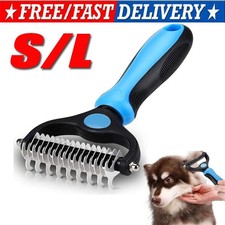
A dog grooming brush for mixed breeds marketed as such is usually a versatile slicker brush — a reasonable default, but not necessarily what the specific coat in front of you needs. A curly-coated mix needs the same frequent brushing and professional trimming as a Poodle. A flat-coated mix with dense undercoat needs the same de-shedding work as a Labrador. The actual coat drives the maintenance requirement.
Designer hybrids: the coat lottery problem
First-generation crosses between two breeds with different coat types — a Poodle cross is the most common example — don't produce a predictable coat. Some Labradoodle puppies from the same litter come out with tight Poodle-type curls; others come out with flat, shedding Labrador coats. You don't know which you have until the adult coat comes in around 18 months, and the grooming implications are substantially different depending on the outcome.
This matters if you chose the hybrid specifically for low-shedding properties. Spend time with the adult dog's coat before assuming it will behave like the Poodle parent.

The costs: professional grooming versus at-home
Professional grooming fees are higher for larger dogs, longer coats, and more frequent required appointments. A long-coated breed — purebred or hybrid — that needs trimming every six to eight weeks costs significantly more over a year than a short-coated breed bathed at home. If budget is a genuine constraint, invest in home grooming skills and a quality home dog clipper set to extend the time between professional appointments, rather than skipping grooming and dealing with matting and skin problems.
What I'd skip
I'd skip taking a mixed-breed dog to a groomer and asking for "the standard cut" — there isn't one. Have a conversation about the coat type and what the maintenance goal is. And I'd skip assuming that because a dog's breed is "low maintenance" its grooming is truly free. Every coat requires some attention; the question is how much and how often.
Ready to shop? Compare Pets across stores →